Air Force Unveils B-2 Spirit Stealth Bomber's New Anti-Ship Capability Amid Pacific Tensions
The iconic B-2 Spirit can now deploy long-range anti-ship missiles, a strategic advancement demonstrated during a recent live-fire exercise in the Western Pacific.
Politics·
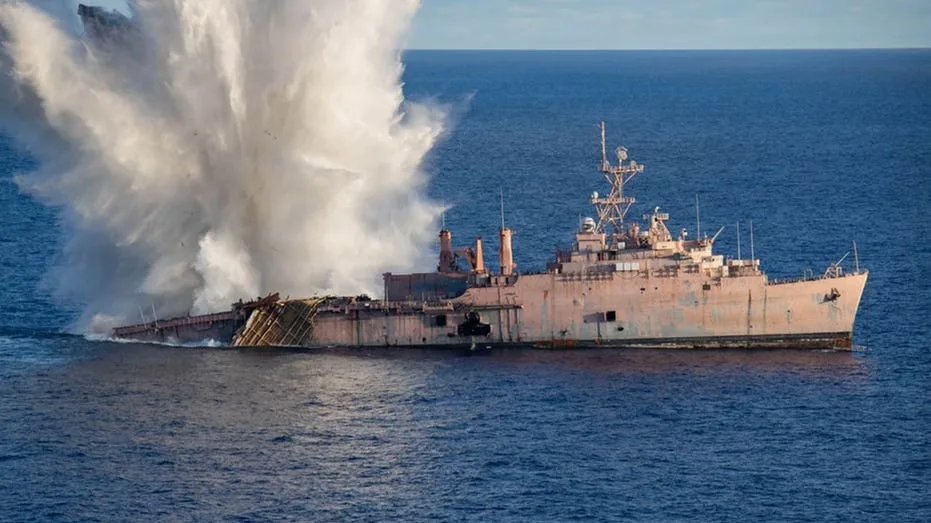
The U.S. Air Force disclosed on Monday that its premier B-2 Spirit stealth bomber has acquired the ability to engage adversary naval vessels using the Long Range Anti-Ship Missile (LRASM). This new operational capacity was publicly revealed following a live-fire demonstration conducted in the Western Pacific.
During Exercise Valiant Shield 26, a significant multinational training event led by the U.S. and involving allied forces throughout the Western Pacific, the stealth bomber successfully deployed a long-range anti-ship missile as part of a sinking exercise situated north of the Mariana Islands.
This revelation emerges as the Pentagon intensifies its strategic preparations for potential contingencies in the Indo-Pacific theater. In this region, the People's Republic of China's rapidly growing naval fleet poses a substantial challenge to U.S. military operations. The public display of the B-2's enhanced maritime strike capability underscores its potential to neutralize significant naval assets.
Strategic Implications in the Indo-Pacific
"The B-2's impressive performance underscores the U.S. military’s commitment to adaptability and flexibility in the face of emerging security challenges," stated Gen. Kevin B. Schneider, commander of Pacific Air Forces. "By prioritizing counter-maritime strike operations, we can maintain a decisive edge over adversaries, protect our national interests and ensure the free and open Pacific that underpin our global security."
U.S. forces, alongside their partner nations, executed a coordinated assault on the decommissioned warship, which had been in service since 1969. Over June 27 and June 28, the vessel was subjected to aerial, surface, and subsurface attacks, ultimately sinking into the Philippine Sea over 200 nautical miles from Guam, as detailed in a Navy report. The decisive strike came from a torpedo launched by a Japan Maritime Self-Defense Force submarine.
China is in the process of further expanding what is already recognized as the world's largest navy. This expansion includes the deployment of various long-range anti-ship missiles, designed to deter U.S. military presence in the Western Pacific. Pentagon forecasts indicate that the People's Liberation Army Navy (PLAN) is projected to increase its battle force ships from over 370 to approximately 435 by the year 2030. In comparison, the U.S. Navy presently operates around 291 battle force ships.
Despite its naval expansion, Beijing has not yet introduced its anticipated H-20 stealth bomber into active service. This leaves the United States with a distinct operational advantage that China has not publicly exhibited: the combination of a stealth bomber with a long-range anti-ship cruise missile, capable of engaging critical naval targets within heavily contested airspaces.
Enhancing Naval Strike Capabilities
While the Long Range Anti-Ship Missile is already integrated on the Air Force's B-1B Lancer and the Navy's F/A-18E/F Super Hornet, its addition to the B-2 provides the Air Force with a unique stealth platform for deploying this weapon.
The B-2 Spirit stands as the Air Force's sole operational stealth bomber, specifically engineered to breach advanced enemy air defense systems while carrying a diverse payload of both conventional and nuclear armaments. In a recent significant deployment, B-2s launched from Whiteman Air Force Base in Missouri to target Iranian nuclear facilities during Operation Midnight Hammer, where they delivered 30,000-pound GBU-57 Massive Ordnance Penetrator bombs in the weapon's initial combat application.
This recent demonstration may also offer insights into future operational capabilities for the B-21 Raider, the Air Force's upcoming stealth bomber, which is slated to succeed the B-2. Although specific anti-ship armaments for the B-21 have not been publicly detailed by the Air Force, officials have indicated its design will accommodate a wide array of stand-off and direct-attack conventional munitions.
The B-21 is anticipated to commence operational service in 2027.
Related Stories

Justice Department Warns States: Report Undocumented Immigrants or Risk Billions in Welfare Funding
The Justice Department has issued a warning to states, indicating potential loss of billions in welfare funding if they fail to report undocumented immigrants to the federal government. This directive significantly
Sep 3

U.S. Military Mandates Testosterone Testing for Male Personnel Aged 30 and Above
The Department of Defense has introduced a new policy mandating testosterone deficiency screening for male service members aged 30 and older. This initiative aims to enhance military readiness, though some medical
Sep 3
FAA Proposes Permanent Flight Restrictions Near Mar-a-Lago Amid Drone Threats; Experts Call Measures Insufficient
The FAA has proposed permanent flight restrictions near Mar-a-Lago, citing national security and drone concerns. While the measures aim to enhance safety, experts argue they are insufficient against determined
Sep 3

Campaign Trail Challenges: When Political Hopefuls Face the National Spotlight
Not every politician is ready for the national stage, as recent campaign cycles illustrate. From controversial statements to perceived policy missteps, candidates like Abdul El-Sayed and Darline Graham demonstrate the
Sep 3